

The Central Financial Work Conference was held in Beijing, where Xi Jinping and Li Qiang delivered important speeches.
Release date:
2023-11-01 14:24
Source:
The Central Financial Work Conference was held in Beijing.
Xi Jinping and Li Qiang delivered important speeches.
Zhao Leji, Wang Huning, Cai Qi, Ding Xuexiang, and Li Xi attended.
BEIJING, Oct. 31 (Xinhua) — The Central Financial Work Conference was held in Beijing from October 30 to 31. Xi Jinping, General Secretary of the CPC Central Committee, President of the People’s Republic of China, and Chairman of the Central Military Commission, attended the conference and delivered an important speech. Li Qiang, Zhao Leji, Wang Huning, Cai Qi, Ding Xuexiang, and Li Xi, members of the Standing Committee of the Political Bureau of the CPC Central Committee, also attended.
In an important address, Xi Jinping reviewed the Party’s financial work since the 18th National Congress, analyzed the challenges facing high-quality financial development, and outlined priorities for the current and forthcoming period. Li Qiang laid out specific measures to ensure the effective implementation of financial policies.
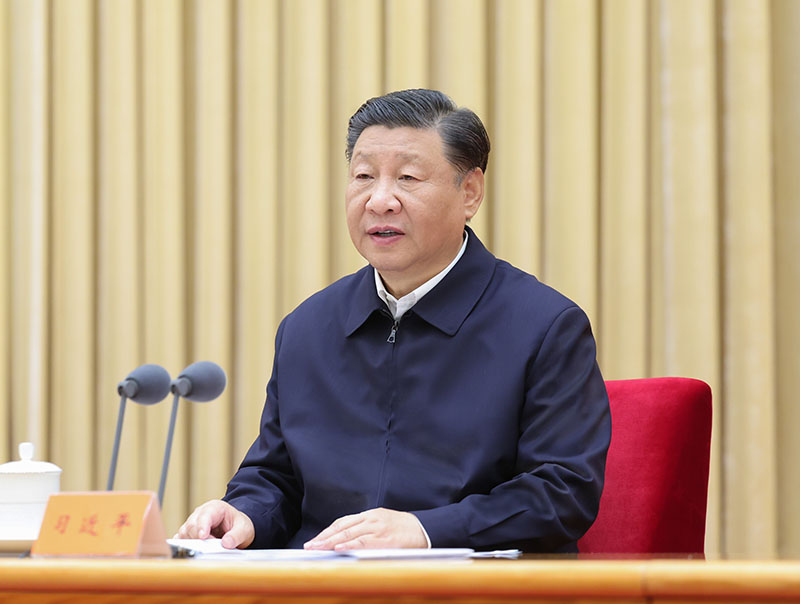
From October 30 to 31, the Central Financial Work Conference was held in Beijing. Xi Jinping, General Secretary of the CPC Central Committee, President of the People’s Republic of China, and Chairman of the Central Military Commission, attended the conference and delivered an important speech. Photo by Xinhua News Agency reporter Ju Peng.
The meeting emphasized that finance is the lifeblood of the national economy and a vital component of the country’s core competitiveness. It called for accelerating the development of a financially strong nation, comprehensively strengthening financial regulation, improving the financial system, optimizing financial services, preventing and defusing risks, and unswervingly following the path of financial development with Chinese characteristics. These efforts will promote high-quality financial development in China and provide robust support for advancing the cause of national rejuvenation and building a modern socialist country through Chinese-style modernization.
The meeting noted that, since the 18th National Congress of the Communist Party of China, under the centralized and unified leadership of the CPC Central Committee, the financial sector has provided strong support for the overall economic and social development, resolutely fought the tough battle to prevent and defuse major risks, and made significant contributions to achieving, on schedule, the goal of building a moderately prosperous society in all respects and realizing the First Centenary Goal. The CPC Central Committee has integrated Marxist financial theory with the concrete realities of contemporary China and with the fine traditional culture of the Chinese nation, striving to grasp the laws governing financial development in the new era. It has continuously advanced practical, theoretical, and institutional innovation in China’s financial undertakings, energetically forging a path of financial development with Chinese characteristics. The meeting emphasized the need to uphold the CPC Central Committee’s centralized and unified leadership over financial work; to adhere to a people-centered value orientation; to regard serving the real economy as the fundamental purpose of financial services; to treat risk prevention and control as the enduring priority of financial work; to promote financial innovation and development along market‑based and law‑based tracks; to deepen supply‑side structural reform in the financial sector; to balance financial opening-up with financial security; and to maintain the overarching principle of seeking progress while ensuring stability. These practical and theoretical achievements have been hard won. At the same time, it is important to recognize clearly that various contradictions and problems in the financial sector are intertwined and mutually reinforcing, some of which remain particularly acute; latent economic and financial risks remain substantial; the quality and effectiveness of financial services to the real economy are still inadequate; financial irregularities and corruption persist despite repeated efforts to curb them; and financial regulation and governance capacity remain weak. The financial system must earnestly raise its political awareness, bear in mind the “big picture of the country,” strengthen its sense of mission and responsibility, and resolve to address these issues at their root, so as to leverage high‑quality financial development in advancing the cause of national strength and the great rejuvenation of the Chinese nation.
The meeting emphasized that, at present and for the foreseeable future, to do a good job in financial work, it is imperative to uphold and strengthen the Party’s overall leadership, take Xi Jinping Thought on Socialism with Chinese Characteristics for a New Era as our guiding principle, fully implement the spirit of the 20th National Congress of the Communist Party of China, and comprehensively, accurately, and thoroughly apply the new development philosophy. We must deeply recognize the political nature and people-centered character of financial work, set the goal of accelerating the building of a strong financial sector, take promoting high-quality financial development as the central theme, regard deepening supply-side structural reform in the financial sector as the main thread, and rely on the integrity, professionalism, and combat effectiveness of the financial workforce as crucial support. With a focus on strengthening regulation across the board and preventing and defusing risks, we must adhere to the overarching principle of seeking progress while maintaining stability, coordinate development and security, firmly safeguard the bottom line of preventing systemic financial risks, unswervingly follow the path of financial development with Chinese characteristics, accelerate the construction of a modern financial system with Chinese characteristics, continuously meet the growing financial needs of economic and social development and the people, and constantly open up new prospects for financial work in the new era.
The meeting noted that high-quality development is the primary task in building a modern socialist country in all respects, and that finance must provide high-caliber services to support economic and social progress. Efforts should be focused on fostering a sound monetary and financial environment and strengthening high‑quality financial services for major national strategies, key sectors, and areas of weakness. Monetary policy must remain prudent, with greater emphasis on both cross‑cycle and counter‑cyclical adjustments, and the policy toolkit should be further enriched. The structure of financial supply should be optimized, directing more financial resources toward advancing scientific and technological innovation, cutting‑edge manufacturing, green development, and small, medium, and micro enterprises. Strong support should be given to the implementation of the innovation‑driven development strategy and the regional coordinated development strategy, while ensuring national food and energy security. Financial resources currently under inefficient use must be revitalized to enhance their efficiency. Five major initiatives—science‑and‑technology finance, green finance, inclusive finance, elderly‑care finance, and digital finance—should be vigorously advanced. Work should be undertaken to build a modern financial institutions and market system and to unblock channels for channeling funds into the real economy. The financing structure should be refined, the capital market’s pivotal role further strengthened, the stock issuance registration system deepened and made more effective, diversified equity financing expanded, the quality of listed companies significantly improved, and first‑rate investment banks and institutional investors nurtured. High‑quality development of the bond market should be promoted. Institutional positioning should be refined: state‑owned large financial institutions should be supported in becoming stronger and more competitive, serving as the mainstay of supporting the real economy and a stabilizing anchor for financial stability; entry standards and regulatory requirements for small and medium‑sized financial institutions should be strictly enforced, with local banks encouraged to pursue specialized operations; policy‑oriented financial institutions should have their roles clearly defined; and the insurance sector should fulfill its functions as an economic shock absorber and a social stabilizer. Market rules must be reinforced to create a unified regulatory framework and foster coordinated oversight, thereby promoting the formation of long‑term capital. Corporate governance should be improved, the modern Chinese‑style financial enterprise system further refined, state‑owned financial capital management enhanced, bank capital‑raising channels broadened, and risk isolation between industry and finance strengthened. Efforts should be redoubled to advance high‑level financial opening-up, safeguarding national financial and economic security. A balanced approach that equally emphasizes “bringing in” and “going out” should be pursued, steadily expanding institution‑based openness in the financial sector, enhancing the convenience of cross‑border investment and financing, and attracting more foreign‑invested financial institutions and long‑term capital to operate and invest in China. The competitiveness and influence of Shanghai as an international financial center should be bolstered, while Hong Kong’s status as an international financial hub should be consolidated and upgraded.

From October 30 to 31, the Central Financial Work Conference was held in Beijing. Xi Jinping, General Secretary of the CPC Central Committee, President of the People’s Republic of China, and Chairman of the Central Military Commission, attended the meeting and delivered an important speech. Li Qiang, Zhao Leji, Wang Huning, Cai Qi, Ding Xuexiang, and Li Xi also attended the conference. Photo by Xinhua News Agency reporter Yan Yan.
The meeting emphasized the need to comprehensively strengthen financial regulation and effectively prevent and defuse financial risks. It called for substantially enhancing the effectiveness of financial oversight by bringing all financial activities under regulatory scrutiny in accordance with the law, and for fully reinforcing institutional, conduct‑based, functional, look‑through, and ongoing supervision. This will eliminate regulatory gaps and blind spots, ensure rigorous enforcement, and demonstrate unwavering resolve in cracking down on illegal financial activities. Risks at small and medium-sized financial institutions must be addressed promptly. A long-term mechanism for preventing and resolving local government debt risks should be established, along with a government debt management framework aligned with high-quality development, and the debt structure of both central and local governments should be optimized. Efforts should be made to foster a virtuous cycle between finance and the real estate sector, improving regulatory frameworks for real estate enterprises and capital flows, and refining macroprudential measures for real estate finance. All types of real estate firms—regardless of ownership—should have their financing needs met in a fair and equitable manner, while policy tools should be deployed in a targeted and flexible way to better support both first‑time homebuyers and those seeking to upgrade their housing. Acceleration of the construction of “three major projects,” including affordable housing, is essential to establish a new model of real estate development. The stable functioning of financial markets must be safeguarded by standardizing issuance and trading practices, appropriately managing market expectations, and preventing the cross‑regional, cross‑market, and cross‑border transmission and amplification of risks. Foreign exchange market management should be strengthened to maintain the basic stability of the RMB exchange rate at an appropriate and balanced level. In addressing and defusing financial risks, it is crucial to strike a balance between authority and responsibility, establishing a risk‑resolution accountability system that aligns powers with duties and ensures compatible incentives and constraints. Likewise, a proper balance between speed and stability must be maintained: while upholding overall stability, decisions should be made with due consideration of timing, intensity, and effectiveness, ensuring that risks are resolved in a solid and prudent manner. Criminal offenses and corruption must be firmly punished, and moral hazard rigorously prevented. Early identification, early warning, early exposure, and early resolution of risks are imperative, supported by a robust, hard‑wired mechanism for the timely correction of financial vulnerabilities.
The meeting emphasized that strengthening the CPC Central Committee’s centralized and unified leadership over financial work is the fundamental guarantee for effectively carrying out financial tasks. It is necessary to improve the systems and mechanisms for Party leadership over financial work, give full play to the role of the Central Financial Commission, and ensure robust overall coordination and oversight. We must also fully leverage the functions of the Central Financial Work Committee to earnestly strengthen Party building within the financial system. Furthermore, local Party committees should make good use of their financial commissions and financial work committees to ensure that responsibilities at the local level are fulfilled. We must adhere to the standards of political integrity, strong competence, and sound conduct, and cultivate a high-caliber, professional contingent of financial cadres who are loyal, clean, and capable of shouldering responsibility. In the financial sector, we should vigorously promote China’s fine traditional culture, upholding principles of honesty and trustworthiness, pursuing profit in accordance with righteousness, maintaining prudence and caution, staying true to fundamentals while fostering innovation, and ensuring compliance with laws and regulations. We must strengthen the rule of law in the financial sector, promptly advance legislation in key and emerging areas, and provide solid legal safeguards for the development of the financial industry.
The meeting emphasized that General Secretary Xi Jinping’s important speech provides a scientifically sound answer to a series of major theoretical and practical questions in the development of the financial sector. It is an essential component of Xi Jinping Thought on Socialist Economy with Chinese Characteristics for a New Era, as well as a significant innovative contribution to Marxist political economy on financial issues, offering fundamental guidance and an action-oriented roadmap for advancing high-quality financial development in the new era and on the new journey. All regions and departments are called upon to study and thoroughly grasp its spirit and conscientiously implement it. We must improve macro‑regulation of finance, accurately understand the patterns and emerging characteristics of supply and demand in the money and credit markets, and strengthen dual‑pronged adjustments to both the overall quantity and structural composition of monetary supply. We should enhance the provision of high‑quality financial services, further open up the financial sector at a high level, and effectively support enterprises “going global” and the Belt and Road Initiative, while steadily and prudently advancing the internationalization of the renminbi. We need to refine the financial regulatory framework, establish and improve systems for assigning regulatory responsibilities and holding accountable those who fail to perform, and effectively prevent and defuse financial risks in key areas. Focusing on the most pressing tasks in the financial sector, we will intensify policy implementation and work progress, ensure reasonably ample liquidity and continued reductions in financing costs, invigorate capital markets, better support the expansion of domestic demand, promote stable foreign trade and foreign investment, and strengthen financial support for new technologies, emerging industries, and new market segments, thereby accelerating the cultivation of new drivers and competitive advantages.
The meeting called on all regions and departments, particularly the financial sector, to further align their thinking and actions with the spirit of General Secretary Xi Jinping’s important speech and the decisions and arrangements of the CPC Central Committee. It emphasized adhering to a goal‑oriented and problem‑oriented approach, comprehensively strengthening the Party’s leadership over financial work, and earnestly advancing key tasks such as enhancing financial regulation, preventing and defusing financial risks, and promoting high‑quality financial development. The meeting also urged accelerating the building of a financially strong nation, effectively publicizing and implementing the spirit of the meeting, bolstering the development of a capable cadre and talent pool in the financial sector, and ensuring that all work plans are fully implemented.
He Lifeng delivered a concluding address. Officials from the People’s Bank of China, the National Administration of Financial Regulation, the China Securities Regulatory Commission, as well as representatives from Beijing, Liaoning Province, Hubei Province, and Sichuan Province, made remarks and shared their experiences.
Members of the Political Bureau of the CPC Central Committee and Secretariat of the CPC Central Committee, relevant leading officials of the Standing Committee of the National People’s Congress, State Councilors, the President of the Supreme People’s Court, and relevant leading officials of the National Committee of the Chinese People’s Political Consultative Conference attended the meeting.
Members of the Central Financial Commission, leaders from all provinces, autonomous regions, municipalities directly under the central government, and cities separately listed in the national plan, as well as the Xinjiang Production and Construction Corps; relevant departments of central and state organs, related people’s organizations, and pertinent departments of the Central Military Commission; and principal officials of centrally administered financial institutions and selected enterprises attended the meeting.
Recommended Updates

Address: No. 80, Lishan Road, Lixia District, Jinan City, Shandong Province, China
Postal Code: 250013
WebChat