

The latest round of the strategic initiative for breakthroughs in mineral exploration has yielded remarkable results: only after scouring countless mountains can one finally uncover gold. (New Economic Frontiers)
Release date:
2023-12-01 14:27
Source:
The latest round of the strategic initiative for breakthroughs in mineral exploration has yielded remarkable results—only after traversing countless mountains can one finally uncover gold. (New Economic Frontiers)
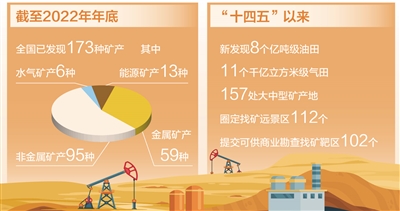
Data source: Ministry of Natural Resources
Cartography: Wang Zheping
Mineral resources constitute an essential material foundation for economic and social development, and their exploration and exploitation are vital to national welfare, people’s livelihoods, and national security. By the end of 2022, 173 types of minerals had been identified nationwide; in 2022, reserves of nearly 40 percent of China’s mineral commodities increased. According to the recently released “China Mineral Resources Report (2023),” the implementation of a new round of strategic initiatives to achieve breakthroughs in mineral exploration has yielded significant results.
General Secretary Xi Jinping emphasized: “We must intensify exploration efforts, strengthen scientific and technological breakthroughs, and play an even greater role in the new round of strategic initiatives to achieve breakthroughs in mineral exploration.” With the goal of safeguarding national energy and resource security, and focusing on bolstering domestic exploration and development of critical energy and mineral resources while increasing reserves and production, the natural resources sector has rallied all stakeholders to vigorously advance this new round of strategic actions, ensuring that the nation’s energy supply remains firmly in its own hands.
Comprehensively advance mineral exploration.
Secure the energy supply.
What is the significance of the new round of strategic initiatives for breakthroughs in mineral exploration?
“Mineral resources are the cornerstone of building a modern industrial system,” said Tang Juxing, Deputy Chief Geologist at the Institute of Mineral Resources of the Chinese Academy of Geological Sciences. He noted that the growth and expansion of strategic emerging industries—such as high-end equipment, new-energy vehicles, and aerospace—require substantial supplies of minerals like copper, aluminum, lithium, and manganese. Taking the new‑energy vehicle industry as an example, statistics show that each vehicle on average consumes 53.2 kilograms of copper, 8.9 kilograms of lithium, 39.9 kilograms of nickel, 24.5 kilograms of manganese, 13.3 kilograms of cobalt, 66.3 kilograms of graphite, and 0.5 kilograms of rare earth elements.
How is the new round of strategic initiatives for breakthroughs in mineral exploration progressing?
A set of figures highlights the achievements: By the end of 2022, China had identified 13 energy minerals, 59 metallic minerals, 95 non‑metallic minerals, and 6 hydrocarbon resources. Since the start of the 14th Five-Year Plan, eight oilfields each containing over 100 million tons of reserves, 11 gas fields each with reserves exceeding 100 billion cubic meters, and 157 large- and medium-sized mineral deposits have been discovered. In addition, 112 prospective exploration areas have been delineated, and 102 commercially viable exploration targets have been proposed. “Based on the current situation, the new round of strategic actions to achieve breakthroughs in mineral exploration is progressing smoothly—more than half of the time has elapsed, and more than half of the tasks have been completed, with expectations that the set objectives will be met,” said Xiong Zili, Director-General of the Department of Geological Exploration Management at the Ministry of Natural Resources.
Given the immense challenges of geological mineral exploration, Ding Zhengjiang, Party Secretary and Captain of the Sixth Geological Brigade of the Shandong Provincial Bureau of Geology and Mineral Resources, offers this analogy: “Driving a drill bit only a few centimeters in diameter through high‑temperature, high‑pressure strata to a depth of 3,000 meters is like trying to push a strand of hair into the earth.” Since its establishment in 1958, the Sixth Geological Brigade has accumulated a total drilling record of 5 million meters and has identified over 2,810 tons of gold resources, making it the nation’s leading gold‑exploration team. The Jiaodong region, where the brigade operates, has also become the world’s third-largest gold‑rich district.
The daily life of mineral exploration teams is far from ordinary—most work takes place in harsh, remote field conditions, where makeshift benches serve as beds, swarms of insects are relentless, and they brave wind and rain. “Only after traversing countless mountains can one finally uncover gold,” says Ding Zhengjiang. “To ensure the authenticity of scientific research in geological prospecting, we must persist in venturing into field sites, deep within mountain ranges and desolate deserts, to gather first-hand data and pristine samples.” Over the past year, the Sixth Geological Brigade has intensified its exploration efforts, conducting surveys to assess the potential of deep‑seated gold resources. In Xilao口, Laishan County, Shandong Province, it has confirmed a large gold deposit containing nearly 50 tonnes; in Hezhang, Guizhou Province, it has helped identify an ultra‑large lead–zinc deposit; it is expected to submit a medium‑sized graphite deposit; and it has delineated nine prospective gold‑prospecting targets. Meanwhile, the brigade has launched successive exploration campaigns in western provinces such as Xinjiang and Qinghai, securing three mining‑rights partnerships. In response to the Belt and Road Initiative, it has also undertaken mineral‑exploration projects in countries including Sudan and Nigeria.
It is precisely the hard work of countless mineral exploration teams that has underpinned China’s status as the world’s largest consumer, producer, and trader of mineral resources. Xiong Zili stated that only by fully implementing the new round of the Strategic Action for Breakthroughs in Mineral Exploration can we firmly hold the “bowl of energy” in our own hands.
Relying on scientific and technological innovation
Leading mineral exploration
Li Kuan, a post‑90s youth, has eight years of experience in mineral exploration with the Sixth Geological Brigade of the Shandong Provincial Bureau of Geology and Mineral Resources. Dressed in bright orange field gear, he swiftly climbs onto the rig after completing his pre‑drilling safety inspection. “Drilling holes, extracting core samples, assigning identification numbers…” Li Kuan describes his work as “sewing intricate patterns with a massive machine”: “Drilling rigs towering more than ten meters stand scattered across the mountains, operating around the clock. With each drill, it becomes immediately clear what the subsurface geological structure looks like and what mineral resources lie beneath.”
“Traditionally, the ‘three essential tools’ of geology—geological hammer, compass, and magnifying glass—were indispensable. Today, however, advanced technologies and equipment such as airborne, spaceborne, drone‑based, ship‑borne, ground‑based, and downhole systems have become essential,” said Luo Qingjun, Director of the Equipment Department at the China Geological Survey. He added that China’s current level of equipment in marine geology, Earth observation, and laboratory testing has now reached world‑class standards.
“Venturing into the Earth’s deep interior.” China’s mineral exploration is shifting from shallow to deep settings, from targeting surface‑exposed deposits to prospecting beneath cover, and from low‑mountain regions to mid‑to‑high mountains and deeply dissected areas—making it increasingly essential to rely on scientific and technological innovation.
Innovation in fundamental theory plays a crucial role in achieving breakthroughs in mineral exploration. Tang Juxing serves as the national chief scientist for copper‑deposit exploration under the new round of the Strategic Action for Mineral Exploration, and has long been stationed in the heart of the Qinghai–Tibet Plateau and its adjacent regions. “We are working to develop metallogenic models and exploration frameworks for copper deposits; this theoretical guidance has yielded remarkable results, with Tibet’s copper resources now accounting for more than two-thirds of China’s total copper reserves.”
Institutional and systemic innovation is a defining feature of the new round of strategic initiatives aimed at achieving breakthroughs in mineral exploration. In 2023, the Ministry of Natural Resources further intensified its support, fully leveraging the roles of various departments, regional authorities, and the nationwide geological survey teams and research institutions. It established an organizational body to implement the mineral exploration campaign, set up an expert advisory committee and an expert guidance group, and provided critical technical advice and on-site technical guidance to ensure the successful execution of the initiative.
Xiong Zili stated that the new round of the Strategic Action for Mineral Exploration Breakthroughs focuses on strategic mineral resources. In line with the overall plan—“stabilize the eastern region, strengthen the central region, accelerate development in the western region, and expand into offshore areas” for oil and gas resources, and “advance deep‑targeted exploration to address blind spots and ensure stable resource supplies in the east, while achieving key breakthroughs and establishing new resource bases in the west”—the initiative designates basic survey zones, priority survey zones, priority exploration zones, and deep‑extension areas around major mines. It will carry out foundational geological surveys, strategic mineral exploration, efforts to conserve and comprehensively utilize mineral resources, and technological innovation in geological mineral prospecting.
Strengthen policy support
A Booming Mining Market
Data show that in 2022, the majority of China’s newly discovered lithium reserves were concentrated in Jiangxi Province, accounting for 94.5% of the total increase. This was largely attributable to a large-scale mineral exploration campaign conducted in Yifeng and Fengxin counties within the Yichun region.
Since 2021, 12 geological teams in Jiangxi Province have deployed more than 1,200 engineering and technical personnel and over 100 drilling rigs to carry out simultaneous operations at this site. Rao Xiaopeng, head of the drilling team at the Maoling mining area in Yifeng County, explained that throughout the project, all work was managed under a “chart‑based” operational model: each time a borehole was completed, it was marked as “closed” on the map, and the footage for every drill hole was also posted on the wall. After more than two years of exploration, the Yichun region has identified four super‑large‑scale and six large‑scale lithium deposits, with reported lithium resources exceeding 8.58 million tonnes.
Substantial discoveries in lithium mineral exploration have strongly propelled the robust growth of Yichun’s lithium‑ion battery and new‑energy industry. At present, Yichun hosts 238 operational enterprises spanning the entire value chain—ranging from lithium mining and processing to the production of cathode and anode materials, separators, lithium‑ion batteries and related components, as well as battery recycling—thus establishing a fully integrated industrial system. The city has adopted a comprehensive “lithium resources–lithium salts–lithium materials–lithium batteries–lithium applications–lithium recycling” end-to-end industrial development model. From January to October this year, the lithium‑ion battery and new‑energy sector in Yichun generated operating revenue of RMB 88.034 billion, up 2.45% year on year.
Bo Zhiping, Director-General of the Department of Mineral Resources Protection and Supervision at the Ministry of Natural Resources, stated that in the latest round of mineral exploration, emphasis has been placed on identifying resources for clean energy and strategic emerging industries. The discovery of lithium deposits in the Yichun region exemplifies how Chinese mining enterprises are positioning themselves in the fields of new energy and advanced resource processing. To accelerate exploration, development, reserve augmentation, and production expansion, nearly 20 lithium‑bearing blocks across Sichuan, Yunnan, Xinjiang, and other provinces are currently undergoing preparatory work for transfer; going forward, additional block allocations will be steadily expanded through various channels, including target‑area assessments and submissions to provincial natural resources authorities.
“Mining enterprises are the primary actors in mineral exploration and bear the critical responsibility of increasing reserves and boosting production,” said Deng Guoping, Director-General of the Department of Mineral Rights Management at the Ministry of Natural Resources. He added that the Ministry has strengthened policy support to help mining companies adjust their development strategies: specifically, by effectively reducing the burden on businesses—through the formal implementation of the Measures for the Collection of Proceeds from the Transfer of Mineral Rights, which shifts the collection method from a one-time payment upon obtaining mining rights to an annual levy based on sales revenue during mine operations—and by standardizing the system for transferring mineral rights, with the successive issuance of supporting documents such as the Guidelines for Determining Market Benchmark Prices for Proceeds from the Transfer of Mineral Rights, thereby further refining policies governing mineral resource exploration and extraction.
In the first half of this year, nationwide investment in exploration for solid mineral resources and oil and gas resources increased by 17.2% and 7.5%, respectively, year on year; 242 new prospecting rights were granted, up 25.4% from the same period last year. Deng Guoping stated that by encouraging “mining‑for‑mines” approaches, lifting restrictions on the splitting and amendment of prospecting rights, and easing limitations on the transfer of such rights, more geologic survey institutions and enterprises with the requisite technology, capabilities, and willingness will be able to obtain prospecting rights, thereby accelerating exploration and development, boosting reserves and production, and safeguarding the critical front line of energy supply security.
Recommended Updates

Address: No. 80, Lishan Road, Lixia District, Jinan City, Shandong Province, China
Postal Code: 250013
WebChat